
How to Answer Single Patient-Centered Vignette Questions if You Have Test Anxiety

In our work helping medical students tackle exam anxiety, this one strategy alone has been PROVEN to raise scores and help our students pass board exams!
You'll see thousands of multiple choice, “single patient-centered vignette” questions your years in medical school. You probably already know what these look like - a bunch of information followed by a question and then a list of answer choices.
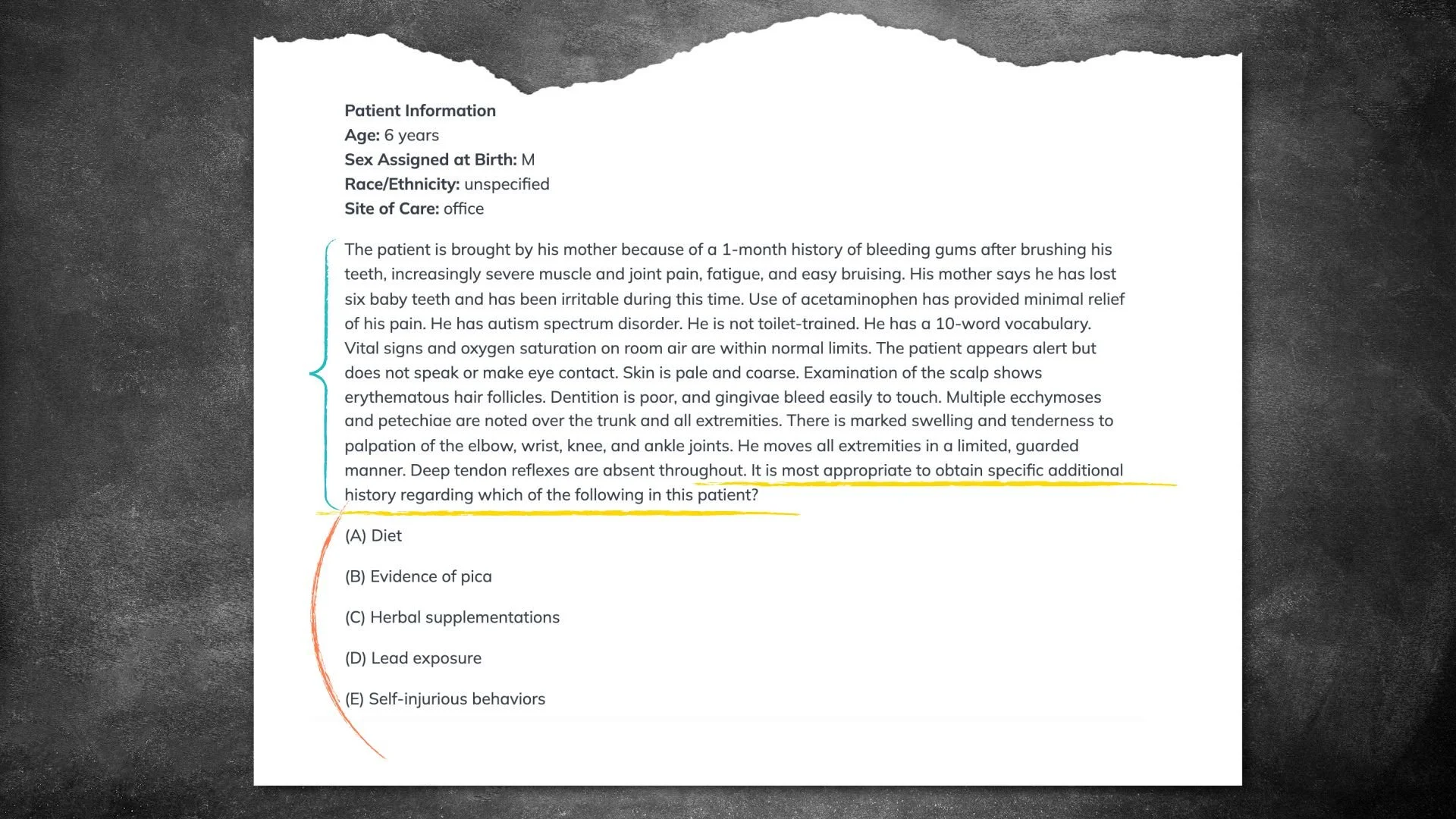
If you experience anxiety around exams, you need a strategy to use when you approach those questions - every time. Being able to master an anxiety-resistant approach to those questions is a huge advantage.
Read the “lead in” first.
The “lead in” is the official name for the sentence that asks the question. When you read the lead in first and then go back and read the context, you save time by knowing what you’re looking for in the case scenario. You also quiet your anxiety, which could have you jumping to conclusions prematurely or getting overwhelmed by all of the information presented. Once you have read through the context, read the question one more time and make sure you understand what it is asking.
Try to predict an answer before looking at the answer choices.
Anxiety hates uncertainty, so if you glance at the answer choices before determining what the answer could be, your brain will try to pick a favorite at random and then your review of the entire question could be altered by the filter of your favorite answer. It can help to actually put your hand on the screen to block the answer choices!
Review all of the answer choices one at a time.
A, is that a good, is that a good answer or not? Cross it out if you're 100% sure it's not the kind of thing you're looking for. If you're not sure, you can leave it uncrossed. Is B what you're looking for? And so on. There is no question that you can't cross out at least one answer.
Narrow it down and choose.
When you narrow it down to two, think of a reason why one would be better than the other. Choose it and don't flag it. A lot of people will flag it if they got stuck on two possible answers and then plan to come back at the end of the session. But if you have anxiety, you can end up with 30 or 40 percent flagged. Make sure that you're flagging things only because you're going to come back and do something differently.
If you start early using this strategy all through your studying period and rehearse it on practice tests, anxiety doesn't have room to hijack what you're doing on test day because you've got a game plan. Even if your heart's racing, you know the steps to approach an individual item.
PRO TIP: It's much better to tell your brain what to do than to tell it what not to do.
Are you an administrator interested in partnering with Test Wolf to support your students’ success? Let us know! We'd love to hear about the challenges you're facing and share the ways we can help.